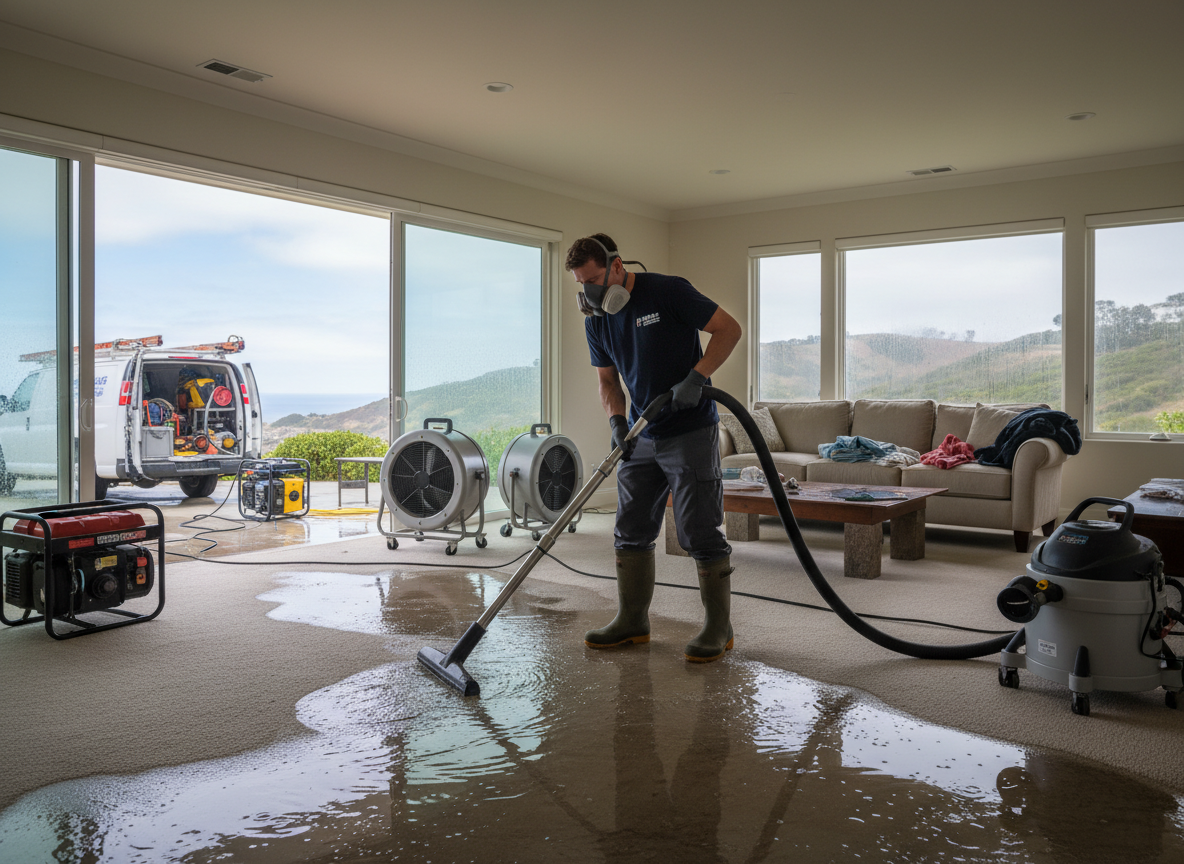
Emergency water removal in Rancho Palos Verdes must account for the mild Mediterranean climate moderated by Pacific Ocean breezes that keeps humidity elevated even after rain stops. Homes along the Portuguese Bend and Terranea corridors often sit on sloped lots where water migrates under slabs or into crawl spaces before residents notice. Equipment choices shift from standard extractors to low-profile wands and air movers rated for salt-laden air to avoid corrosion during multi-day drying cycles.
Older ranch-style houses near the Rolling Hills Estates border and Los Verdes Golf Course frequently feature original plumbing that fails at joints hidden behind cabinets or under tile. Once water reaches hardwood or engineered flooring common in Seaview properties, delamination can begin within hours if extraction skips the subfloor. Technicians check for hidden pockets by lifting baseboards and using moisture meters calibrated for the local stucco and plaster walls that hold moisture longer than drywall.
Terrain around Abalone Cove Shoreline Park and San Pedro borders creates runoff patterns that push water against foundations during rare but intense winter storms. Crews stage equipment at the 31204 Palos Verdes Dr W address for quick deployment to these hillside addresses where narrow driveways limit truck access. Extraction stops only after readings drop below ambient levels to prevent secondary mold growth in the ocean-influenced air.
Technician insight
In Rancho Palos Verdes, the thing that catches most people out with Emergency water removal is the way ocean breezes keep relative humidity high around Portuguese Bend and Terranea homes, so even after pumps finish the slab or crawl space under 1970s stucco can stay damp for days longer than inland jobs.
Kitchen Leak in Seaview Residence
A supply line under a sink failed overnight in a Seaview home. Water traveled under the tile into the adjacent hallway subfloor. Extraction removed standing water from three rooms and moisture meters guided drying of the slab edge. Follow-up readings confirmed levels matched the surrounding structure before equipment was removed.
How it works
- 1
Arrival and Safety Shutoff
Technicians reach the property, locate the water source, and secure electrical and gas lines before any extraction begins.
- 2
Standing Water Extraction
High-volume pumps and wands remove bulk water from floors, carpets, and hard surfaces in affected rooms.
- 3
Moisture Mapping
Infrared cameras and meters identify hidden saturation in walls, subfloors, and insulation throughout the structure.
- 4
Targeted Drying Setup
Air movers and dehumidifiers are placed according to the home's layout and the ocean-moderated humidity levels.
Pricing
Upfront quotes provided after inspection; cost varies with water volume, affected square footage, and number of rooms requiring drying.